
What Do We Want AI to Do for Us?
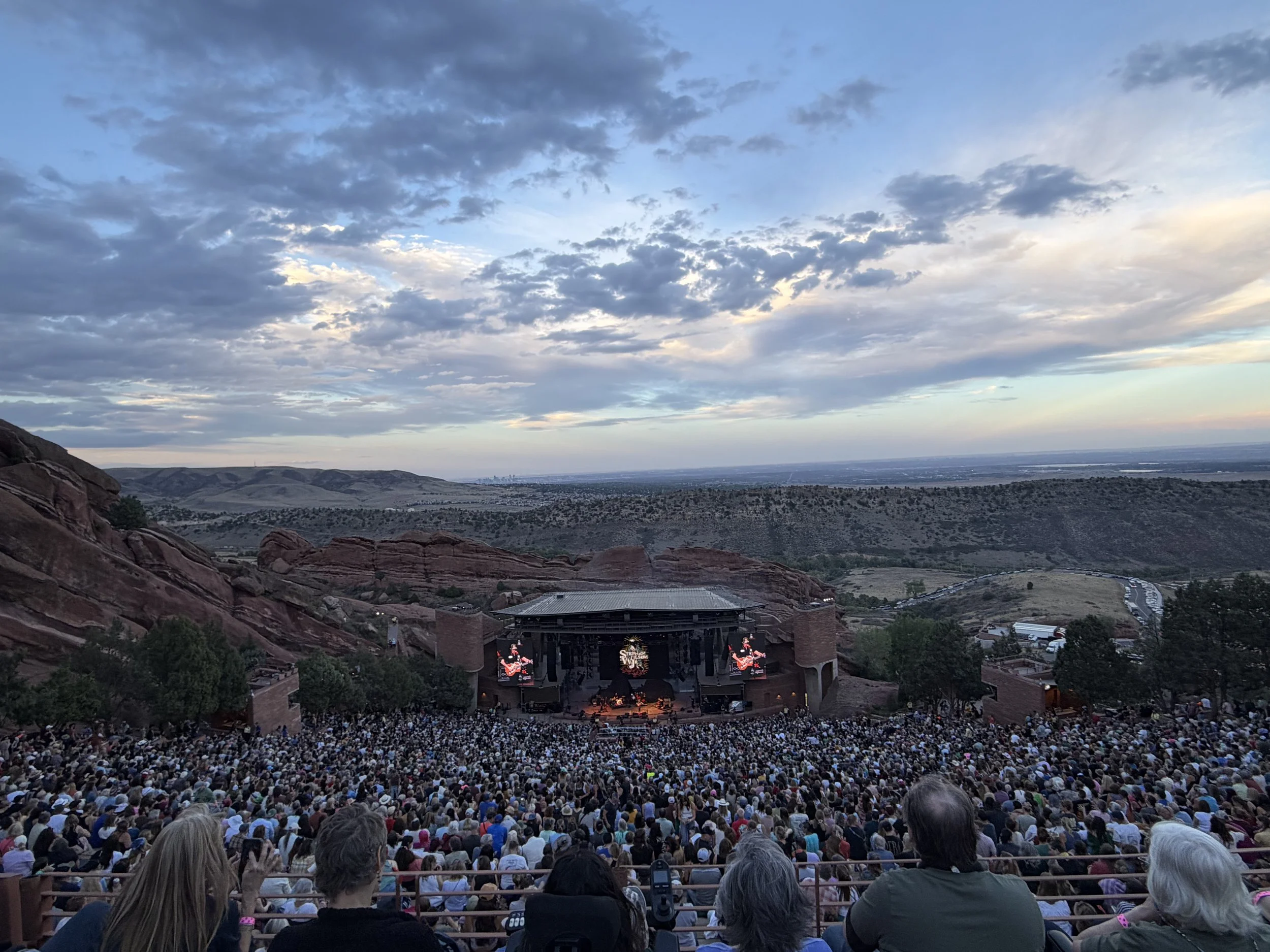
Brandi Carlile Concert -Red Rocks 2026. Photo credit: SCM.
Lately, I’ve been thinking this may be one of the most important questions we should be asking ourselves.
Some time ago, I listened to Brené Brown and Adam Grant talk about artificial intelligence on The Curiosity Shop.
Adam made a comparison that stayed with me: replacing human creation with AI can be a little like using performance-enhancing substances in sports.
You may run faster. But… is it still the same race?
And that raises another interesting question: What is the point of running? Is it only to win?
There was another idea from that conversation that immediately resonated with me. Adam said that when he listens to music, he wants to hear songs that were born from an experience. From heartbreak. From joy. From something lived.
And I couldn’t agree more!
I Experienced It Firsthand
A few days ago, I went to see Brandi Carlile at Red Rocks. She became widely known for her song The Story.
The truth is, I wasn’t particularly a fan of hers. A friend of my husband’s who is a big fan came from Chile, so the three of us went to the concert together.
And I loved it!! I was deeply moved. And it wasn’t just her voice. It was the stories behind her songs.
Before each song, Brandi would share where the lyrics came from. She talked about the people, places, emotions, and experiences that had inspired them.
And suddenly, I heard each song differently. They were no longer simply beautiful words set to a melody.
There was a lived experience behind those words.
And I shed a few tears when she sang You Without Me.
Brandi shared that the song was born from those small moments when you begin to discover your children as independent people. Those “you without me moments”: moments when you begin to catch a glimpse of who they will become without you.
My oldest daughter is 15. By the time I was 16, I was already in college and living independently (and I still remember the mix of sadness and joy my mom felt).
Perhaps that’s why the song touched me so deeply.
Because the lyrics speak to that profoundly human contradiction of loving someone deeply while, at the same time, learning to let them fly.
Of knowing them, walking alongside them, and having built part of your own story with them, while accepting that the time will come when they need to walk their own path.
And letting go doesn’t mean losing the connection. The relationship changes. Our roles may change too. Distance may play a part. But when the connection is real, it remains.
When One Story Touches Another
Lately, I’ve been feeling those small separations with my daughter. That strange mix of pride and nostalgia as I watch her become more and more independent.
And as I listened to Brandi sing something born from her own experience as a mother, I couldn’t help but connect it to mine.
Her story touched my story.
She lived something. She turned it into words and music. I listened through the lens of my own story, and something inside me responded.
That is human connection.
And I thought: This is exactly what I don’t want to delegate.
Not Everything We Can Delegate Is Something We Want to Delegate
I use AI. And I think it is an extraordinary tool.
It can help me research, learn, organize, question, explore, and expand possibilities.
But I don’t want it to live for me. And I don’t want to delegate the things I love doing either.
Writing, for example. Because writing, for me, isn’t simply about producing words.
It’s a way of thinking, discovering myself, and making sense of what I experience. It’s part of how I enjoy the journey.
It is, as Arthur Brooks might put it, not just research, but “me-search.”
And very often, it is precisely through that process of self-reflection, born from a lived experience, that something irreplaceable emerges for me: connection.
First, with myself.
And then with another person—a real, flesh-and-blood human being—who sends me a private message and says:
“This happened to me too…”
One experience meets another. One story recognizes itself in another.
The Question Isn’t Only What AI Can Do
So, as we continue to be amazed by everything AI can do, perhaps we need to ask ourselves another question:
What do I want to keep doing myself, even if AI can do it for me?
And perhaps we also need to ask ourselves what we are consuming—and what we actually want to consume.
To consciously choose when we want something created by a human being, when we’re comfortable with something generated by AI, and when we want something that combines both worlds.
Because, forgive me, but I simply can’t imagine a robot creating and singing, instead of Shakira, the songs she wrote after her husband cheated on her.
It just wouldn’t be the same!!
Because part of what connects us to a song, a book, a painting, or a story isn’t only the final result.
It’s knowing that someone felt something before creating it.
That there is a lived experience behind it.
And that, somehow, their life can touch ours.
What Do We Want to Preserve?
This may well be one of the most interesting challenges AI is placing before us.
Not only deciding how we want to use it, but consciously deciding which parts of the human experience we want to preserve.
Not because a machine can’t produce something similar. But because perhaps the value of some things will never lie solely in the outcome.
It is also in the process. In having thought it. In having felt it. In having lived it.
There are things we don’t just want to be well made.
We want to know—and feel—that they were lived.
✎ What is something in your life or work that, even if AI could do it for you, you still choose to do yourself?
